The art of clay courts: tradition combined with superior technical precision
In Spain, clay is much more than just a playing surface. It is part of tennis culture, the development of great players and the sporting experience offered by clubs, academies and professional facilities. Its rhythm, bounce and ability to encourage a technical style of play make it one of the most highly valued surfaces among players of all levels.
However, not all clay courts perform equally well. The difference lies not only in the visible surface material, but in everything beneath it: the ground preparation, the drainage layers, the compaction, the levelling and the technical precision with which each stage of construction is carried out.
At Universal Sport Instalaciones, we combine the tradition of clay courts with advanced technical criteria and stringent engineering standards, such as the DIN standard, to build courts that are more stable, efficient and suitable for intensive use.
Why is a track built to technical standards superior?
A clay court must provide a comfortable, even and safe surface for players. However, it must also perform well in the face of external factors such as rain, continuous use or changes in temperature.
Many traditional tracks suffer from drainage problems, soft patches, waterlogging or uneven loss of material. These faults usually arise when the track has not been constructed to an appropriate technical standard.
Our methodology focuses on accuracy right from the start.
A perfect 1% gradient for efficient drainage
One of the key aspects of a clay court is water drainage. To achieve this, we ensure the surface is precisely levelled with a 1% gradient, designed to allow water to drain away from the court naturally and in a controlled manner.
This technical detail makes a huge difference to the day-to-day use of the facility. After heavy rain, a properly constructed court can be used again much sooner, whilst other surfaces may remain waterlogged for hours.
The result is a more functional court, with fewer interruptions to play and greater availability for clubs, academies and users.
Manufactured in accordance with the DIN standard
At Universal Sport Instalaciones, we work to international quality standards that enable us to monitor every stage of the construction process. The DIN standard helps us to ensure that the drainage layers, the base and the playing surface have the correct compaction, grain size distribution and stability.
This results in a more uniform surface, which performs better under continuous use and offers a more consistent playing experience. For the player, this translates into a more comfortable, predictable and professional experience.
Less maintenance and greater durability
A track that is properly constructed right from the base not only improves drainage. It also reduces erosion, prevents premature deformation and makes day-to-day maintenance easier.
When the levelling is correct and the layers are laid properly, the track retains its properties better, requires fewer corrective measures and helps to optimise long-term maintenance costs.
For sports clubs, municipal facilities, hotels, resorts and tennis academies, this offers a significant advantage: more playing time, fewer incidents and a more cost-effective investment over time.
Engineering applied to gaming
Building a clay court is not simply a matter of spreading material over a surface. It requires technical knowledge, experience and attention to every detail.
At Universal Sport Instalaciones, we view the court as a complete sports facility, where each layer serves a specific purpose and every construction decision has a direct impact on the final performance.
That’s why we don’t just build pitches. We use engineering to ensure the game never stops.
If you’re looking for a clay court that offers high performance, efficient drainage, low maintenance and professional technical installation, at Universal Sport Instalaciones we can help you bring your next project to life.
A noticeable difference: before and after the rain
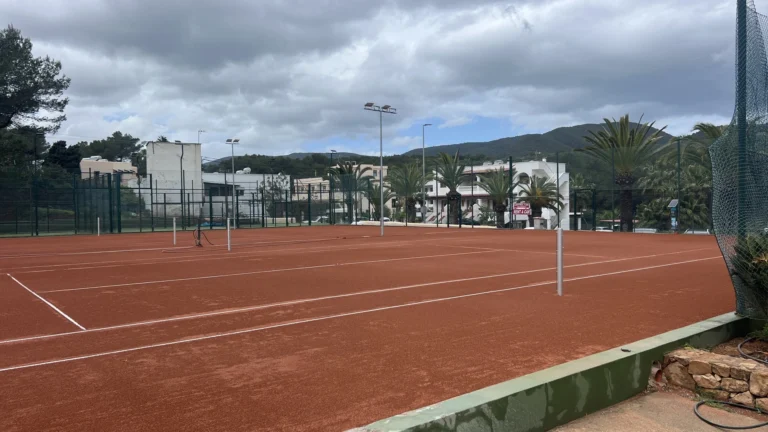
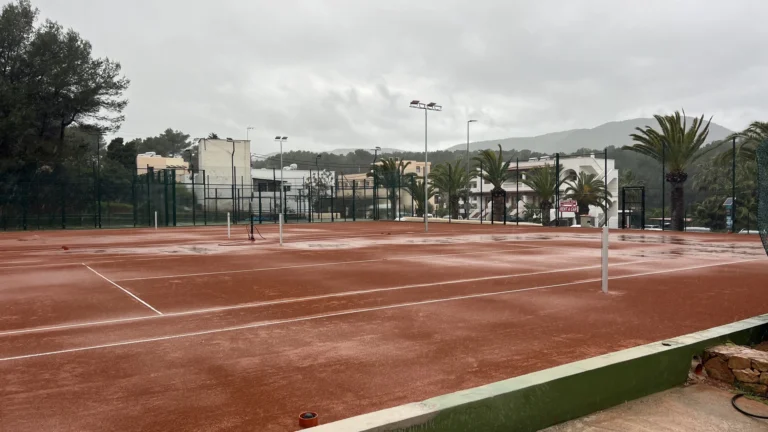
The drainage of a clay court cannot be explained by technical data alone; it must also be demonstrated visually. That is why one of the best ways to check the quality of a well-built court is to observe how it behaves immediately after rain and compare it with its condition an hour later.
The first image shows the track shortly after it had rained, with the surface still damp following heavy rainfall. The second image, taken approximately an hour later, shows how the water has gradually drained away thanks to the correct levelling, the 1% gradient and the appropriate composition of the drainage layers.
This comparison clearly highlights one of the main advantages of a court built to professional standards: a quicker recovery, less downtime and a surface that is ready for play in better condition.
When it’s raining:
An hour later: